


Methanol has long been one of the world's most widely used and traded chemical commodities. Recently, methanol has attracted growing interest for a different reason: its potential role in decarbonizing hard-to-electrify sectors. As renewable methanol production expands and pressure increases to decarbonize industrial value chains, industry, shipping, and aviation are increasingly exploring how methanol and methanol-derived fuels can contribute to their decarbonization ambitions.
Together, these developments are transforming methanol from a traditional industrial feedstock into a molecule that could connect multiple sectors within the energy transition. These pathways offer opportunities to reduce lifecycle greenhouse gas emissions while building on existing production and distribution infrastructure.
Renewable methanol production capacity is scaling
The growing interest in methanol across industry, shipping and aviation is being accompanied by rapid expansion of renewable methanol production capacity. There are two main renewable methanol categories: biomethanol and e-methanol. Biomethanol could be produced from biomass and biogenic waste streams such as agricultural residues. E-methanol on the other hand, is made of green hydrogen and renewable CO₂ such as biogenic CO₂. DNV's analysis highlights substantial growth in both biomethanol and e-methanol project pipelines, with production capacity expected to increase significantly throughout this decade (see Figure 1). While project development is occurring globally, a large share of announced renewable methanol capacity is currently located in China (~70%).
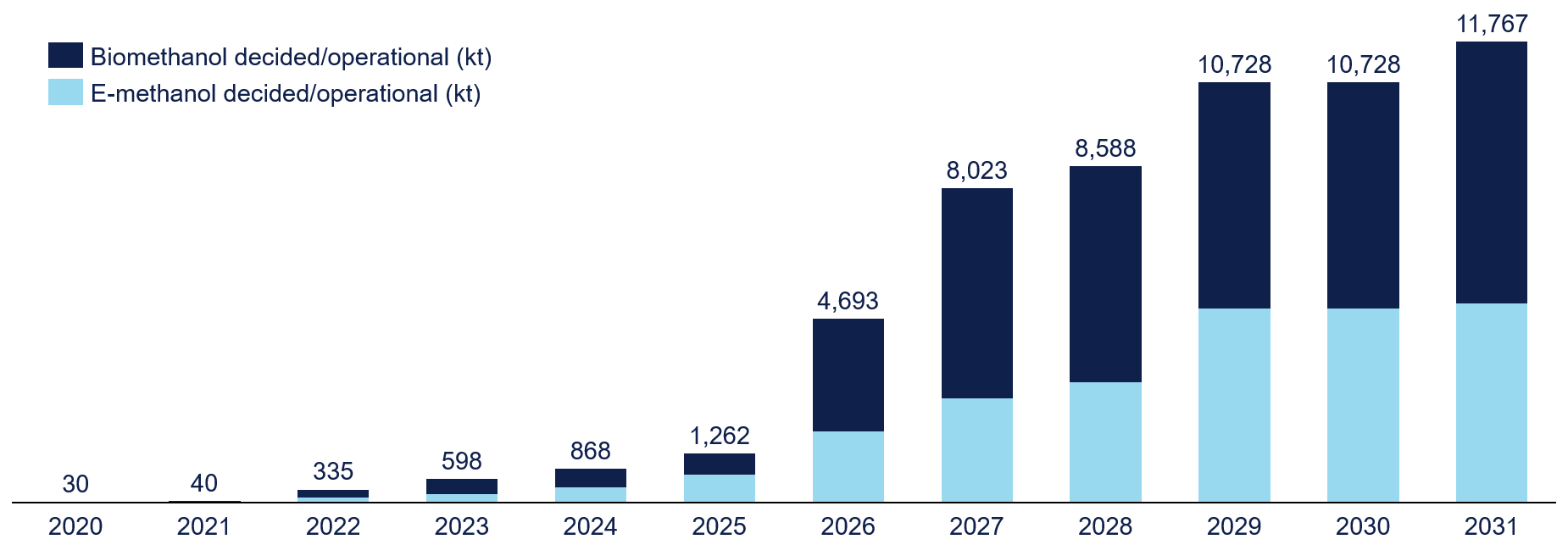
This growth is important because methanol's potential extends beyond a single market. Renewable methanol can act as an energy carrier linking renewable electricity, carbon sources and end-use sectors. As production volumes increase, opportunities emerge not only for shipping and existing industrial users, but also for entirely new applications, including sustainable aviation fuels.
Aviation is entering the picture
While shipping has become a leading adopter of methanol, aviation is increasingly examining how methanol could contribute to the future sustainable aviation fuel (SAF) mix. In Europe, ReFuelEU Aviation is creating a rapidly growing market for SAF. The industry exceeded the initial 2025 mandate, supplying around 1.1 Mt of SAF and surpassing the required blend rate. SAF demand is expected to rise from around 2.8% of jet fuel demand in 2025 to 6% in 2030 and 70% by 2050. Within this, a dedicated synthetic aviation fuel (e-SAF) sub-mandate will increase from 1.2% in 2030 to 35% in 2050, creating a substantial new market for renewable fuels (see Figure 2).
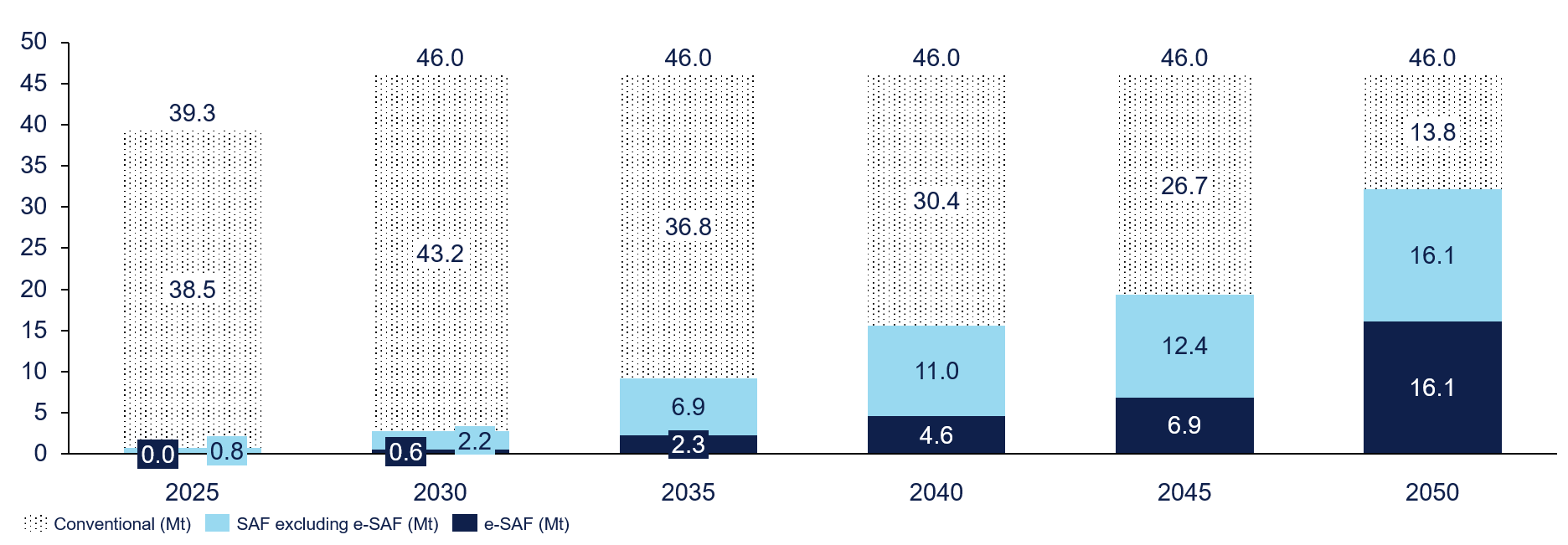
As aviation searches for scalable feedstocks beyond conventional biomass, methanol-to-jet (MtJ) pathways are emerging as a promising route to supply part of this growing e-SAF demand. The process converts methanol into aviation fuel through a series of industrial processes. Methanol is first converted into light olefins, which are subsequently transformed into kerosene-range hydrocarbons before final upgrading into jet fuel blend components.
A key advantage of MtJ is that it builds on industrially proven technologies and could lower emissions from jet fuel (ReFuelEU aviation mandates 70% emissions savings). The pathway leverages experience in methanol synthesis, methanol-to-olefins technologies, and refining processes. Rather than starting from a blank sheet, developers are able to utilize technologies and expertise that already exist at commercial scale.
ASTM approval opens new opportunities
A major milestone for the MtJ pathway came in 2026 when American Society for Testing and Materials (ASTM) D7566 was updated to include methanol as an approved feedstock for synthetic aviation fuel production. Under the pathway, Methanol-to-Jet Synthetic Paraffinic Kerosene (MTJ-SPK) can be blended with conventional jet fuel at up to 50%, removing a significant commercialization barrier. The approval provides greater confidence for project developers, investors and airlines.
Multiple licensors have developed commercial-scale MtJ technologies, while technology developers continue to advance projects and commercialization efforts.
Strong interest, early-stage market
Interest in MtJ is growing rapidly across Europe. Developers including Verso Energy, Elyse Energy, Metafuels, Smartenergy, Power2X, and P2X Europe are actively pursuing projects across the region. Several large-scale developments have already been announced (see Figure 3).
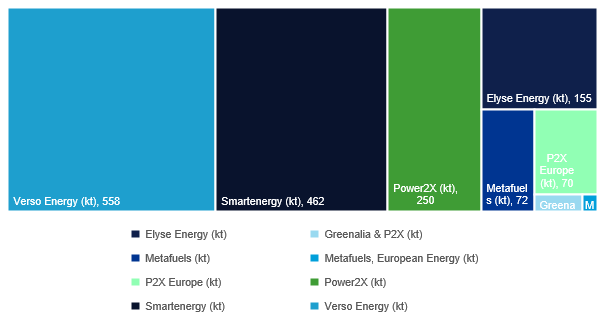
At the same time, commercialization remains at an early stage. DNV estimates that approximately 1.6 million tonnes of MtJ capacity are represented within the current project pipeline in the Europe. However, projects remain concentrated in Pre-Front-End-Engineering Design and Front-End Engineering Design phases, with no final investment decisions (FID) yet taken among the projects identified in the assessment.
This reflects a broader challenge within Europe's synthetic aviation fuel landscape. While a sizeable project pipeline exists, project maturity remains the key bottleneck. Many projects must still progress through engineering, permitting, financing and construction before significant fuel volumes become available. DNV sees several priorities to enable e-SAF plants to take FID:
• Long-term certainty could be provided around ReFuelEU mandates and in particular sub-mandates for e-SAF;
• E-SAF support mechanisms such as double-sided auctions could be introduced to create revenue certainty for producers;
• Grid connections and other infrastructure development could be accelerated by accelerating permitting for instance.
Outlook on methanol-to-jet
Developments across industry, shipping and aviation suggest that methanol is entering a new phase. While shipping has emerged as an important market for renewable methanol, aviation is increasingly positioning itself as the next opportunity. Supported by growing SAF and e-SAF mandates, ASTM approval, and an expanding renewable methanol supply base, the MtJ pathway is gaining momentum as a scalable route to sustainable aviation fuel.
Although the market remains at an early stage, with most projects still progressing towards FID, MtJ has the potential to connect renewable methanol production with a growing SAF demand. As a result, aviation could become an increasingly important driver of future renewable methanol demand.
Find out more about DNV: https://www.dnv.com/